The complete guide to chasing a deal on WhatsApp without losing it or annoying anyone
You sent the quote on Monday. It is Thursday and there is nothing. The chat now sits under a delivery question and a wrong number, and every hour you leave it there it gets colder.
Here is the message that gets an answer:
Hi Marta, checking in on the quote I sent you. Does the scope look
right, or should I change something?
No apology. No "just following up". One question, and an easy way to say no. That is the whole craft, and the rest of this guide is that message in eighteen situations, plus the part almost everybody gets wrong: sending it on the right day instead of whenever you happen to remember.
By the end you will have:
- 18 follow-up messages you can copy, in the eight situations that cover almost every deal
- A timing table that tells you how many days to wait for each one
- A free scheduler that writes the message, saves the date and opens the chat for you, with no account
- The four ways to schedule a WhatsApp message, including the only one that sends by itself
Let's get started.
Why Deals Die on WhatsApp
Nobody loses a lead on purpose. It just scrolls.
An inbox sorts by who wrote last, not by who is about to buy. So the customer who asked for a price on Monday ends up below three people asking where their order is, and the only thing keeping that deal alive is your memory. Memory holds two or three deals. It does not hold forty.
The fix is not a better message. It is deciding, at the moment you send the quote, what day you will chase it, and making that day arrive with the message already written.
The Timing Table
These are the intervals we use, and the same ones the free scheduler picks by default. They are recommendations, not laws: read the room and move a day either way.
| What just happened | Send the next message | Why that gap |
|---|---|---|
| They asked a question and you have not answered | Within the hour | Speed is the whole advantage of WhatsApp |
| You sent a quote or a proposal | 3 days | Long enough to read it, short enough to still be warm |
| They said they need to check internally | 7 days | Their meeting has to happen first |
| They missed a call or an appointment | Same day | The excuse is fresh and forgiving |
| They said yes but have not paid | Next morning | Momentum dies overnight |
| They went quiet after a real conversation | 3 days, then 10, then stop | Two more tries, not seven |
| The deal was lost months ago | 30 days or more | Budgets and jobs change on that clock |
Three days is not a number we invented for this article. It is the mark our sales funnel board uses to flag a chat as Cold, because that is roughly when a warm conversation stops feeling like a conversation and starts feeling like a memory.
Pick Your Situation
Every template below is written for a specific moment. Jump to yours.
| I want to write to someone who... | Go to |
|---|---|
| just asked about your product | They just asked |
| got your quote and said nothing | After a quote |
| went quiet mid conversation | They went quiet |
| said it is too expensive | The price objection |
| missed the call | The no show |
| is waiting on their own team | Waiting on their team |
| agreed but has not paid | Agreed, not paid |
| said no months ago | Reviving an old deal |
| you have already chased twice | The last message |
They Just Asked
Send within the hour. This is a New lead, and the only competitive advantage you have here is being the one who answered first.
Hi Marta, thanks for writing. I can help with the starter plan. Two
quick questions so I do not waste your time: what do you need it for,
and by when?
If you already know what they need, skip the questions and promise a time instead:
Hi Marta, got your message about the starter plan. I am sending you
the details today. Anything specific you want me to include?
Two questions is the ceiling. A questionnaire on WhatsApp reads like a form, and forms get ignored in a place people use to talk to their family.
After a Quote
Send three days later. The deal is in Negotiation and your job is to make it cheap for them to answer.
Hi Marta, checking in on the quote I sent you. Does the scope look
right, or should I change something?
If the quote was big or the buyer was hesitant, take the pressure off instead:
Hi Marta, no rush on the quote. If this is not the right month, say so
and I will come back to you later instead.
That second one works better than it sounds. You are not asking for a yes, you are asking for a date, and a date is something people can give you without committing to anything.
👉 Want the message and the reminder set in twenty seconds, from your phone? Open the free WhatsApp follow-up scheduler and pick the situation. No account, nothing to install.
They Went Quiet
Send three days after the last message. Someone who stops replying mid conversation is not offended, they are busy. Make it easy to restart.
Hi Marta, you went quiet on the quote, which is completely fine. Is it
a no for now, or is it waiting on something?
Or the one line version, which gets the highest reply rate of anything here because it can be answered with a single word:
Hi Marta, one line is enough: still interested, or shall I park it?
Do not send a photo of a dog asking if they are still alive. It is funny once, to one person, and it tells everyone else that you have nothing new to say.
The Price Objection
Send the same day, while the number is still on the table. Never answer a price objection with a discount you were not asked for.
Hi Marta, understood on the budget. Two ways to go: I take something
out of the quote and the price drops, or we keep it as is and split
the payment. Which one helps more?
If you would rather find out what they can actually spend:
Hi Marta, if the number is the problem, tell me the number that works
for you and I will tell you honestly whether I can do it.
And when the objection is a cheaper competitor rather than a budget:
Hi Marta, I know the other quote is lower. What you get for the
difference is same day answers and the setup done for you. If price is
the only thing that matters here, take theirs and I will not be
offended.
All three keep the value of what you sell intact. One changes the scope, one changes the calendar, one lets them walk. None of them apologises for the price.
The No Show
Send within the hour, and be the one who is relaxed about it.
Hi Marta, we missed each other today, no problem at all. Does the same
time tomorrow work, or would you rather I send the answer in writing?
If the call matters enough to insist:
Hi Marta, sorry we did not manage to talk. Give me two times that suit
you this week and I will send the invite.
Offering the written option wins more deals than it loses. Plenty of buyers avoid calls, and you just gave them a way to keep buying without one.
Waiting on Their Team
Send a week later. Your contact is now selling for you inside a company you cannot see. Make their job easier.
Hi Marta, has your team had a chance to look at the proposal? Happy to
answer questions directly for whoever has them.
The version that actually moves things, because it hands them something forwardable:
Hi Marta, do you need anything from me for the internal decision? I can
send a one page summary that is easy to forward.
Agreed, Not Paid
Send the next morning. This is the most expensive gap in the whole funnel: the deal is won everywhere except in the bank.
Hi Marta, we are all set. I am holding your slot until the end of the
week. Shall I send the payment link?
Or remove the last decision from their plate:
Hi Marta, last step is the payment. Do you prefer a link or a bank
transfer?
Notice that neither message asks whether they still want it. Asking reopens a decision they already made.
Reviving an Old Deal
Send a month later, or six. A lost deal is not a dead one. Budgets reset, the person who said no changes job, the problem gets worse.
Hi Marta, we talked about this a while back and the timing was wrong.
It may be better now. Worth a look?
Hi Marta, quick one: is this still on your list for this year? If it is
not, I will stop nudging you.
The Last Message
After two follow-ups with no reply, send this one and stop.
Hi Marta, I do not want to keep filling your phone. I will leave this
here and you write to me whenever it makes sense. Good luck with the
launch.
This message gets replies. Not always the reply you want, but an answer beats an open loop, and the ones who do come back arrive without you having earned a reputation as the person who sends five messages in a row.
That is eighteen. Copy the ones that fit how you actually talk, change the words that do not, and keep them somewhere you can reach in ten seconds.
Make Sure You Actually Send It
Writing the follow-up is the easy half. The half that loses deals is remembering on Thursday what you promised yourself on Monday.
Our free WhatsApp follow-up scheduler does that half, without an account and without installing anything. It is three taps, and this is each of them.
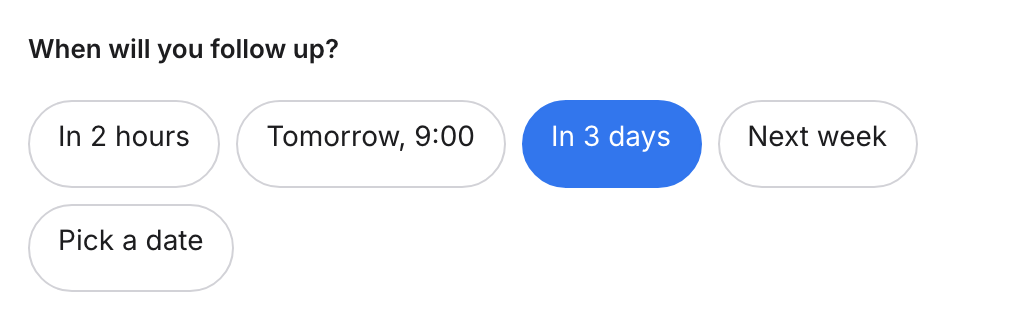
Step 1: Tap when you will chase it
In 2 hours, tomorrow at nine, in three days, next week, or a date you pick. The options are the intervals from the timing table above, so after a quote the one you want is In 3 days.
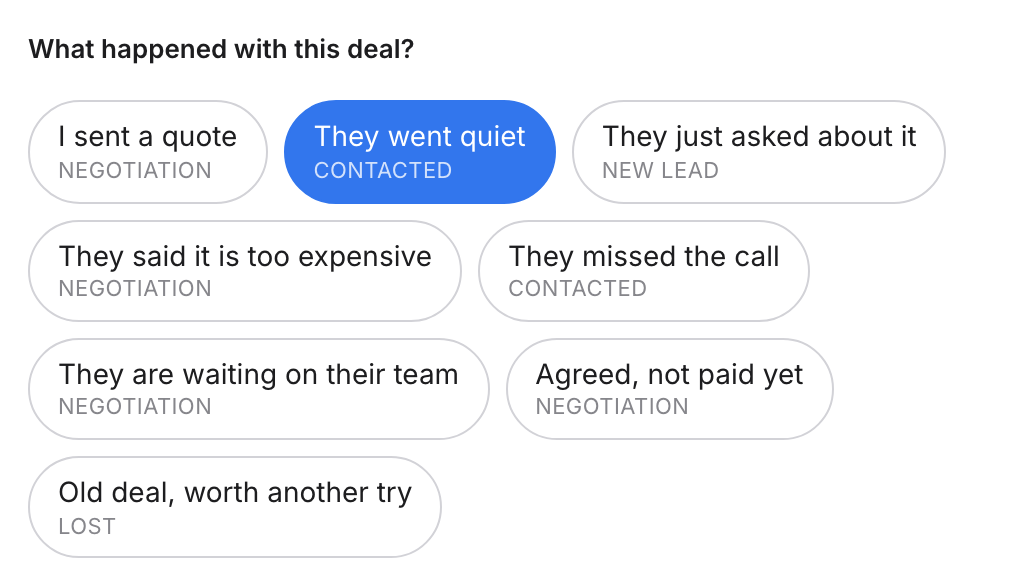
Step 2: Tap what happened
Quote sent, went quiet, too expensive, missed the call, and the four others from this guide. Each chip carries the funnel stage that situation belongs to, which is the same vocabulary the board further down this page uses. Tapping the chip you already chose gives you the second wording.
Step 3: Take the message, the reminder and the link
Add their name and what you last sent them and the message writes itself, with their first name in it and your words in place of "the quote". Add their number as well and you get a link that opens the chat with the text already typed. The reminder goes into your calendar for the day you picked, carrying both.
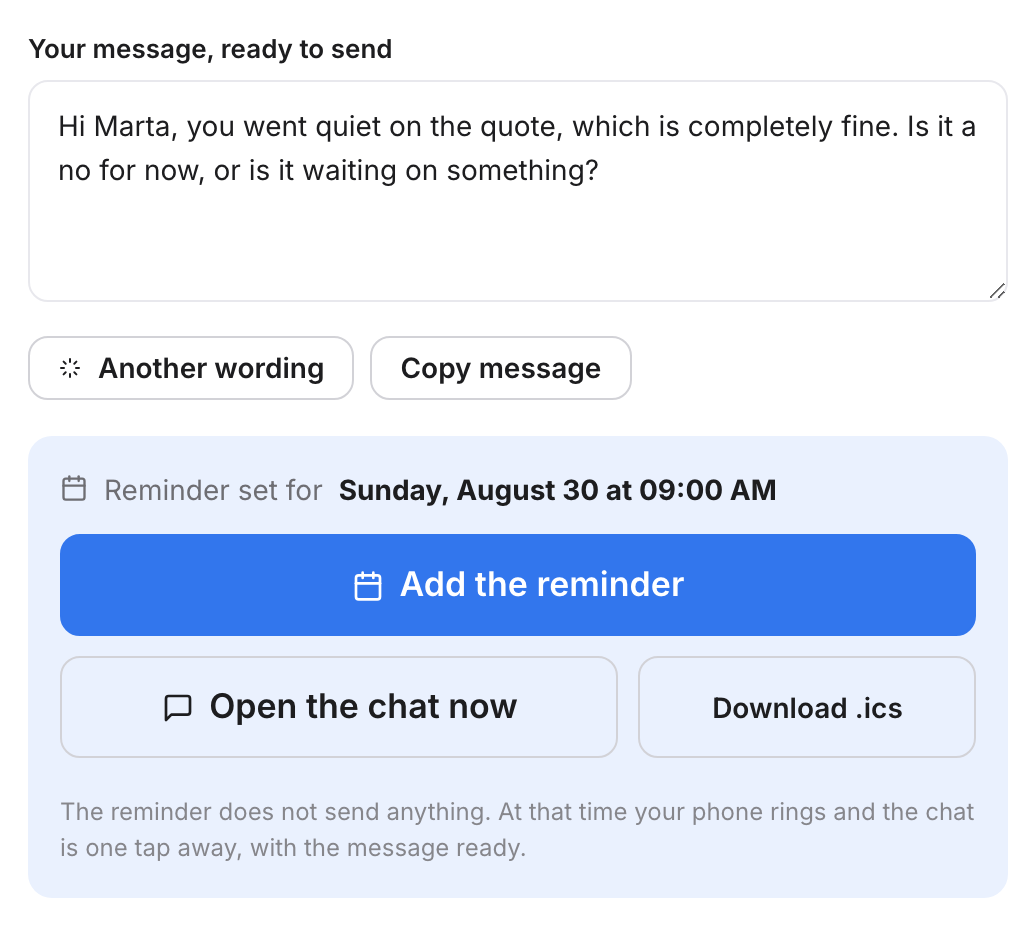
Be clear about what that last step does, because most pages selling you something here are not: the reminder does not send anything. At the time you chose, your phone rings and the chat is one tap away with the message ready. You still press send, which on a first follow-up is usually what you want anyway, because you get to change one word after reading what they wrote last.
Everything you save stays in your browser. We never see it.
Four Ways to Schedule a WhatsApp Message
WhatsApp itself has no send later button, on iPhone or on Android. So there are exactly four ways to make a message arrive later, and only one of them is automatic.
| Method | Sends by itself? | Cost | Good for |
|---|---|---|---|
| Phone reminder plus a wa.me link | No, you tap send | Free | One to five follow-ups a week |
| Android third party apps | Sometimes, and they break with each update | Free to cheap | People who accept the risk |
| WhatsApp Business API scheduling | Yes | Paid | Teams and anything with a deadline |
| Someone on your team remembering | No | Expensive | Nothing |
The last row is not a joke. It is what most small teams are running on right now, and it is the only method on this list whose failure rate goes up as sales go up.
The Link You Can Build by Hand
The link in the first row is worth knowing, because it works everywhere and needs nobody's permission. Take the number in international format, drop everything that is not a digit, and put your message in the query string:
https://wa.me/14155550142?text=Hi%20Marta%2C%20checking%20in%20on%20the%20quote
Open that on any phone and the chat opens with the text already typed, even if the number is not in your contacts. Our free WhatsApp link generator builds these if you would rather not encode the text yourself.
The Only Way That Sends by Itself
If you want the message to leave without you, that is the API. In Wassenger you write it in the chat, click the clock icon, pick a time at least five minutes away and it goes out whether or not your phone is on. Same thing from code:
curl -X POST https://api.wassenger.com/v1/messages \
  -H 'Content-Type: application/json' \
  -H 'Token: YOUR_API_KEY' \
  -d '{
    "phone": "+14155550142",
    "message": "Hi Marta, checking in on the quote I sent you.",
    "deliverAt": "2026-09-03T09:00:00Z"
  }'
One field, deliverAt, and the follow-up is no longer your problem. The clock icon route, with the screenshots, is in Schedule messages.
👉 Start a 7 day free trial and schedule your first message in five minutes. No credit card required.
When One Person's Follow-Ups Become a Team's Pipeline
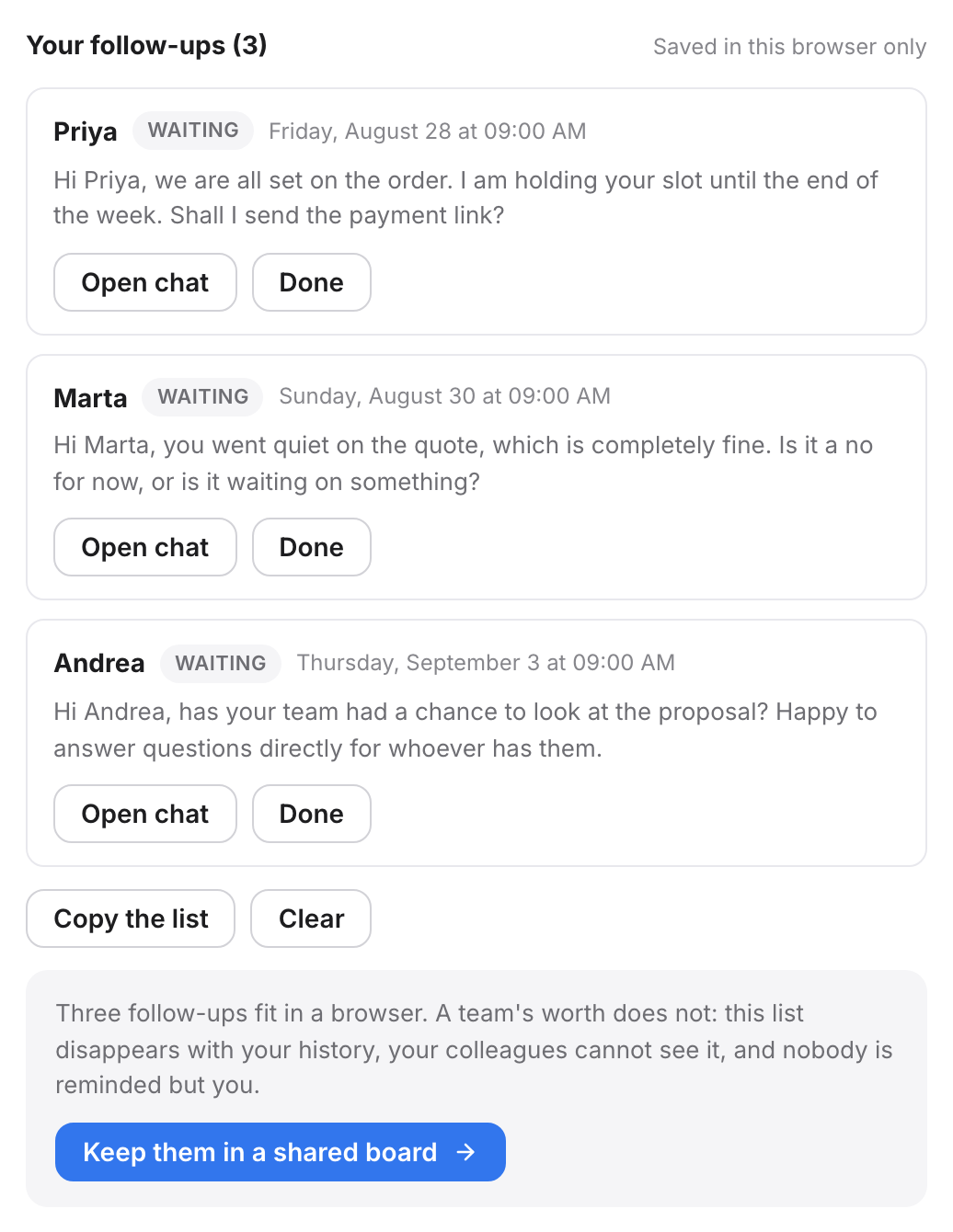
A browser tab holds three follow-ups. It does not hold a team's worth: your colleagues cannot see it, nobody else gets the reminder, and clearing your history clears the lot.
That is the point where the follow-up stops being a message and becomes a pipeline. In Wassenger the pipeline lives inside the same shared inbox your team already answers from, on the same WhatsApp number, so there is no second tool to keep in sync and nothing to import.
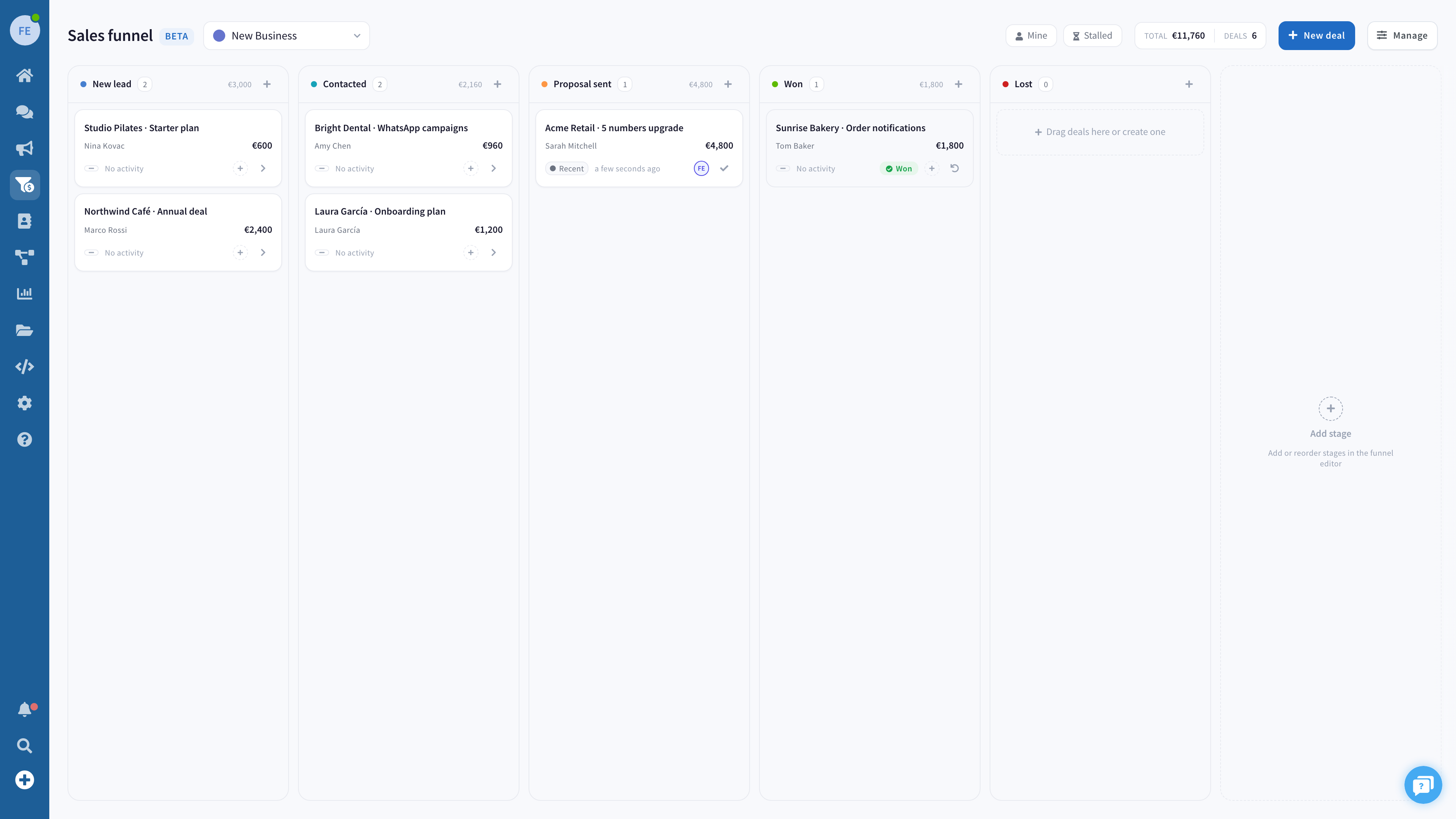
Every open deal is a card in a column. The board arrives with five stages that already work, New lead, Contacted, Negotiation, Won and Lost, and you drag a card to move a deal. You can rename them to whatever your team actually says, which is why the middle one reads Proposal sent in these screenshots. Sales funnels walks through building one.
Stalled and Cold, on Every Card
The two badges do the job this whole article is about. A deal that sits in a stage past the deadline you gave that stage wears Stalled. A chat nobody has touched in three days reads Cold. Two filters, Mine and Stalled, cut the board down to what is yours and what is going stale, which is a shorter list than you fear and a longer one than you hoped.

You set those deadlines yourself in the pipeline editor. In the one above only Contacted carries a limit, three days, so a deal that sits there longer gets flagged and the rest are left alone. That column is the timing table from the top of this article, enforced by the board instead of by your memory.
The Deal Lives Where the Conversation Does
Each one to one chat also carries a Sales funnel panel, so a deal is created without leaving the conversation, and a deal can start from a bare phone number and adopt the chat as soon as that person writes to you.

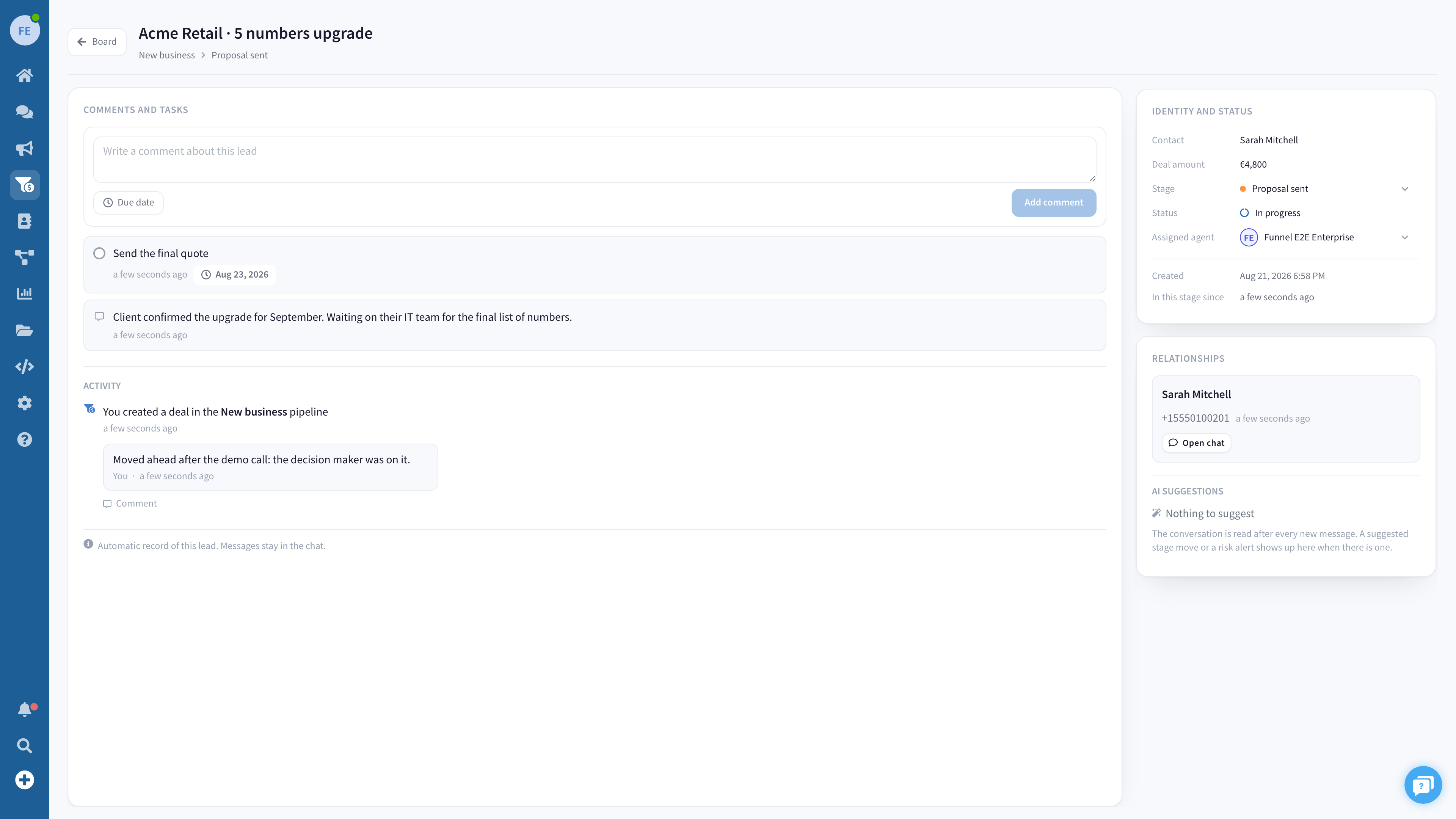
Open a card and you get the record: private comments your customer never sees, tasks with due dates, and every move the deal made with who did it and when. That is where a follow-up stops being a reminder on one person's phone and becomes something a colleague can pick up halfway through.
A Second Opinion That Never Touches Your Board
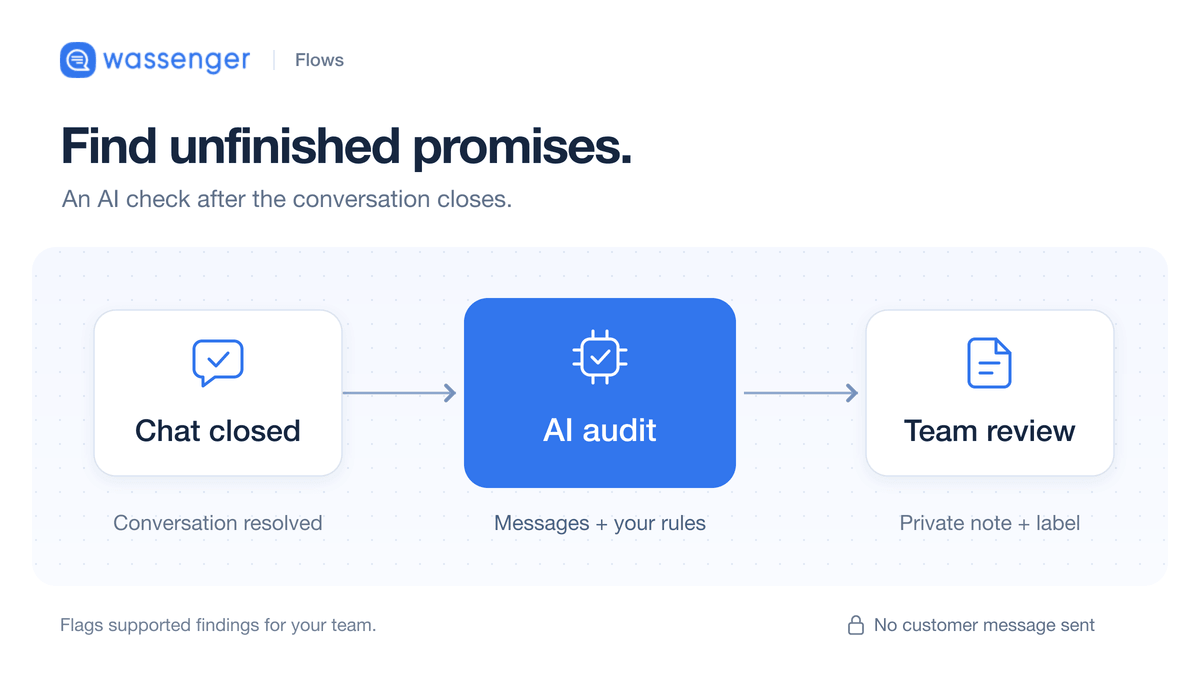
Half an hour after a conversation with an open deal goes quiet, the AI reads the recent messages and leaves one of two things on the deal: a suggested stage move, or a warning that it looks at risk. Each carries a one line reason and the sentence from the chat it rests on.
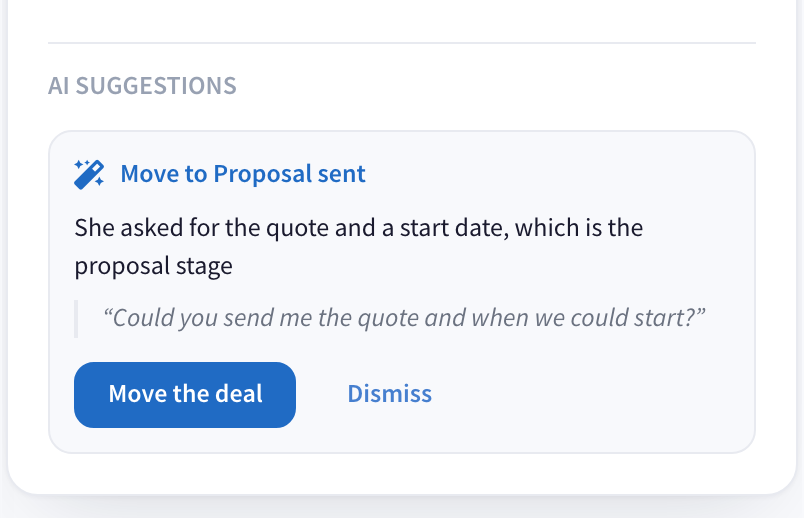
It never moves anything. Accepting is the ordinary stage move, and it never proposes Won or Lost, because closing a deal should not be one click away from a sentence a customer wrote.
Three honest caveats, because you will find out anyway:
- The board is in beta.
- It is not in the mobile app yet. The board and the deal record are screens in the web console.
- The AI suggestions ride on the AI assistant, so they start on the Business plan. Professional carries the board and one funnel without them; Business carries three funnels, Enterprise ten.
Troubleshooting
They read it and did not answer.
- Your message probably asked for a decision. Ask for information instead: one question with a one word answer.
- Check the time you sent it. A follow-up at 21:40 gets read in bed and answered never.
You have already followed up twice.
- Send the last message and stop. A third nudge with nothing new in it converts nobody and costs you the fourth conversation, months from now, when they actually need you.
The wa.me link opens WhatsApp but no chat.
- The number is not in international format. Drop the zeros, the brackets and the spaces, and keep the country code:
+1 (415) 555-0142becomes14155550142. - Or that number is not on WhatsApp at all. Our free number checker tells you in one tap.
Your follow-ups read like a template.
- Name the thing. "The quote" beats "our offer", and "the samples we sent on Tuesday" beats both.
- Delete the first sentence. "I hope this message finds you well" is where a human stops reading.
Your First Five Minutes
Do this on the phone you send from. On a phone the card comes before the pitch, so the tool is the whole first screen:
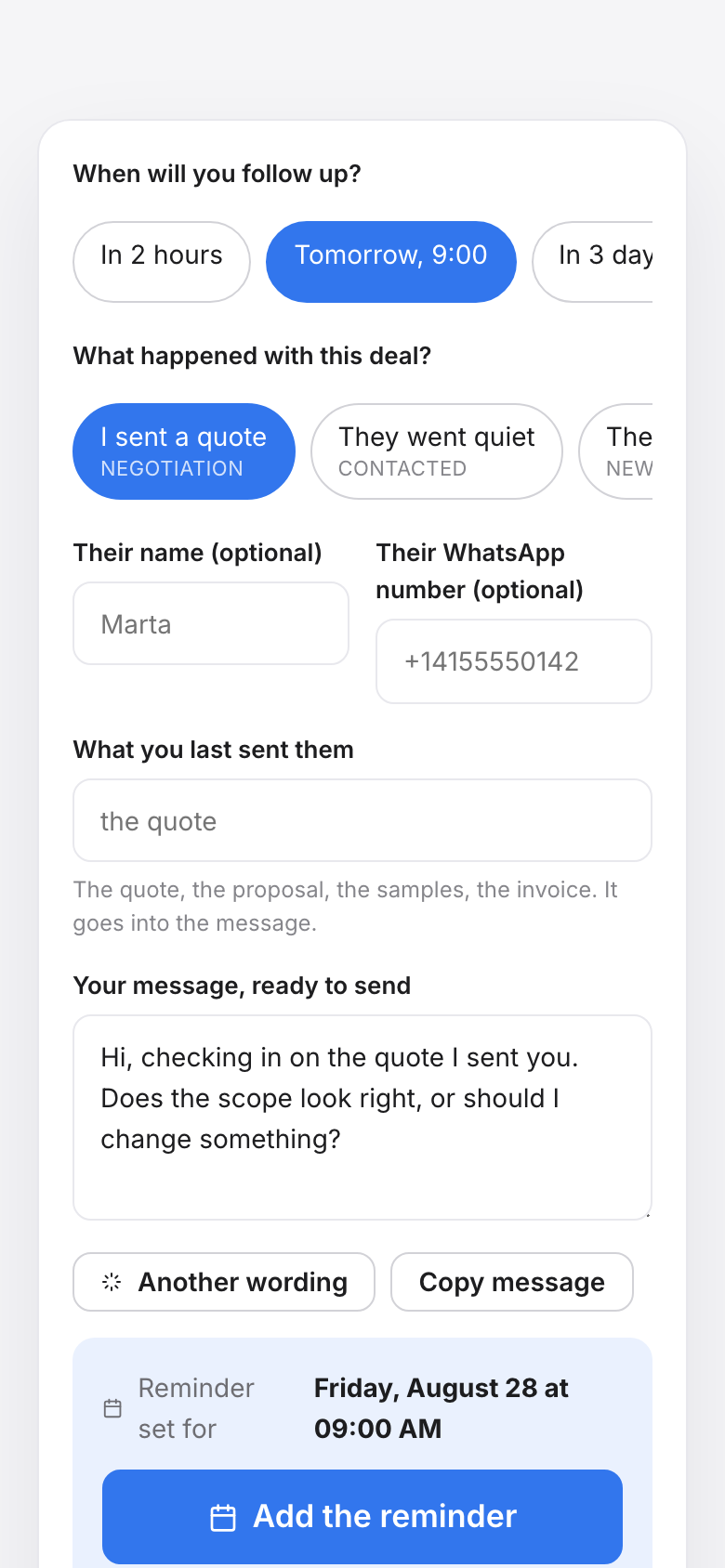
- Open the follow-up scheduler on your phone.
- Think of the deal you feel worst about. Tap the situation that matches it, the row in Step 2 above.
- Add their number, add the reminder to your calendar, save it to the list.
- Do it twice more with the next two deals you are avoiding.
- Look at the three of them together. That list, with dates on it, is a pipeline. Now decide whether you want it living in a browser tab.
Three deals in, this is what you are looking at, and it is also the moment the browser stops being enough:
👉 Start your free trial on Wassenger and put those deals on a board your whole team can see, inside the WhatsApp inbox you already use. 7 days free, no credit card.
Keep Reading
- How to schedule messages on WhatsApp: the easy guide
- WhatsApp sales pipeline: track every deal in your inbox
- Create automatic customer follow-up messages with WhatsApp
- Schedule messages, the help guide for the clock icon
- Sales funnels, the help guide for the board